Understanding Spray Foam R-Value: What Tyler Homeowners Need to Know
When you're evaluating insulation options for your Tyler home, R-value is one of the most important metrics to understand. R-value measures thermal resistance, or how effectively a material slows heat transfer. The higher the R-value, the better the insulation performance. However, not all insulation materials achieve the same R-value at the same thickness, which is why spray foam has become increasingly popular among homeowners seeking efficient solutions.
Closed Cell Spray Foam Insulation typically delivers between 6.0 and 7.0 R-value per inch, making it one of the most efficient insulation options available. In contrast, Open Cell Spray Foam Insulation provides approximately 3.5 to 3.6 R-value per inch. This means that to achieve the same thermal resistance, you would need significantly more open cell foam than closed cell foam. Understanding this difference is crucial when deciding whether your attic needs a complete spray foam application or just strategic air sealing and a partial top-up.
R-Value Requirements by State: What Does Texas Require?
Texas has specific energy code requirements for attic insulation, and Tyler homeowners should be aware of the minimum standards in their climate zone. The state generally recommends R-38 to R-60 for attic insulation depending on your specific location and the type of heating and cooling system in your home. Smith County, where Tyler is located, falls into a zone that typically requires R-38 minimum for new construction, though many energy-conscious homeowners opt for R-49 or higher to maximize efficiency and long-term savings.
If your home currently has inadequate insulation, you have two main paths forward. The first is installing a complete Attic Spray Foam Insulation system, which can achieve the required R-value in fewer inches due to spray foam's superior performance. The second option is assessing whether your existing insulation can be supplemented with air sealing and a partial spray foam top-up. Many older homes in Tyler have fiberglass batts or blown-in cellulose that, while degraded, still provide some baseline insulation value. A professional energy audit can determine which approach makes the most sense for your specific situation.
How Thick Should Spray Foam Be? The Thickness Question
The thickness of spray foam insulation depends on your target R-value and the type of foam you select. Since closed cell spray foam achieves approximately 6.5 R-value per inch on average, reaching R-38 would require about 5.8 inches of material. To hit R-49, you would need roughly 7.5 inches. Open cell foam, being less dense, requires proportionally more thickness to achieve the same results. For most Tyler homes seeking to meet or exceed code requirements, closed cell spray foam applied at 5.5 to 8 inches thick is the standard recommendation.
However, not every attic needs full-depth spray foam coverage. If your home already has 3 to 4 inches of existing insulation in decent condition, a 2 to 3 inch top-up of spray foam combined with meticulous air sealing may be sufficient to reach your target R-value. This hybrid approach can be more cost-effective than a complete tear-out and reinstallation. The key is having a professional evaluate your current insulation, identify air leaks, and calculate the precise thickness needed to meet Texas energy codes and your personal comfort goals. Contact Tyler Spray Foam Insulation at (430) 205-3083 to schedule a professional assessment.
Air Sealing vs. Full Spray Foam: Which Option Is Right for Your Tyler Home?
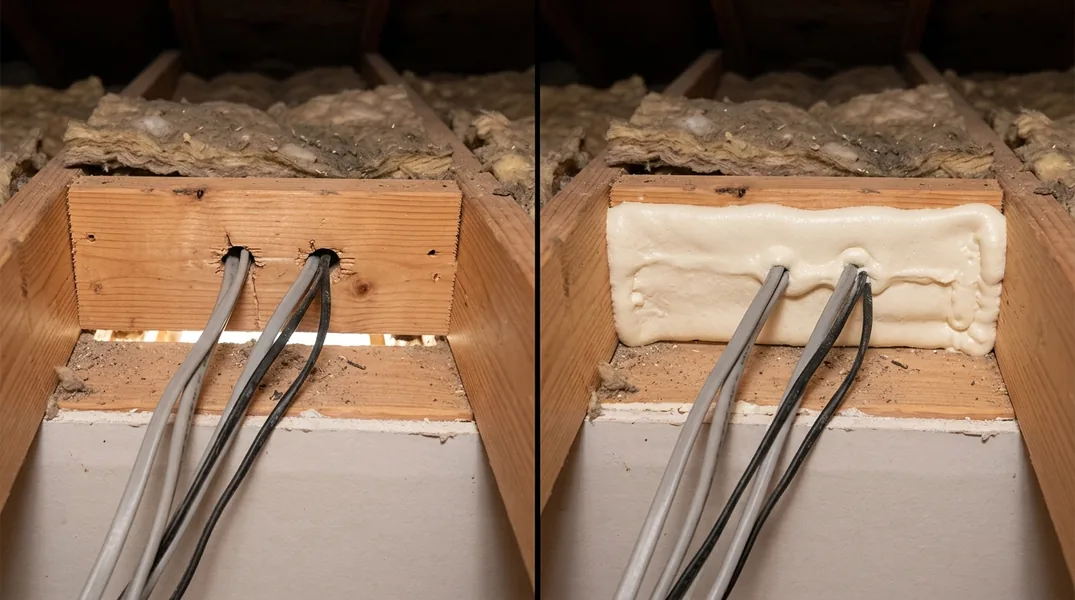
Air sealing and spray foam insulation serve different but complementary purposes. Air sealing focuses on closing gaps, cracks, and penetrations where conditioned air escapes or outside air infiltrates. These problem areas are often found around electrical outlets, recessed lights, pipe penetrations, and the attic floor perimeter. A thorough air sealing job can reduce energy loss by 15 to 30 percent on its own. Spray foam insulation, by contrast, adds thermal resistance and simultaneously provides air sealing benefits because of its expanding, gap-filling nature.
For many Tyler homes, the most practical and cost-effective solution is a combination approach. If your attic insulation is relatively recent and in good condition but has noticeable air leaks, starting with comprehensive air sealing followed by a strategic spray foam top-up may deliver excellent results at a lower investment than a complete spray foam overhaul. Conversely, if your insulation is old, compressed, or missing in patches, a full Attic Spray Foam Insulation installation will provide superior performance and longevity. The decision ultimately depends on your current condition, budget, and long-term energy goals.
Rebates: Making Your Upgrade More Affordable
One of the most overlooked advantages of upgrading your home's insulation is the potential for federal and state tax incentives. The Inflation Reduction Act, which took effect in 2023, significantly expanded insulation rebates for homeowners who improve their home's energy efficiency. For spray foam insulation projects, this can translate into substantial savings.
In addition to federal credits, many utility companies in Texas offer insulation rebates to encourage energy-efficient upgrades. Oncor Electric Delivery, which serves Tyler, periodically offers rebate programs for attic insulation improvements. Before starting your project, it's worth contacting your local utility provider to ask about current incentive programs. When you reach out to Tyler Spray Foam Insulation for a free estimate, our team can help you understand which rebates you may qualify for, making your insulation investment even more attractive financially.
Attic Spray Foam Insulation Cost in Tyler: What to Budget
The cost of attic insulation varies based on several factors, including the size of your attic, the type of spray foam selected, whether you're doing a full installation or a top-up, and local labor rates. Closed cell spray foam is more expensive per square foot than open cell foam, but its superior R-value per inch often means you need less material overall. In Tyler, full attic spray foam insulation typically ranges from $1,500 to $4,000 or more, depending on attic size and complexity. A partial top-up with air sealing may cost significantly less, often in the $800 to $2,000 range.
While the upfront cost matters, it's essential to consider the long-term return on investment. A well-insulated attic can reduce your heating and cooling costs by 10 to 20 percent annually, which for many homeowners translates to payback periods of 5 to 10 years. The federal insulation tax credit ended on December 31, 2025, so ask your utility company about any current rebates instead. To get an accurate pricing quote tailored to your specific home and needs, call Tyler Spray Foam Insulation at (430) 205-3083 or request a free estimate online. Our team will evaluate your current insulation, discuss your goals, and provide transparent pricing for either a full spray foam installation or a strategic top-up approach.
Looking for a professional spray foam insulation contractor in Tyler? Tyler Spray Foam Insulation responds fast for all your spray foam insulation needs.
Get a Free Quote