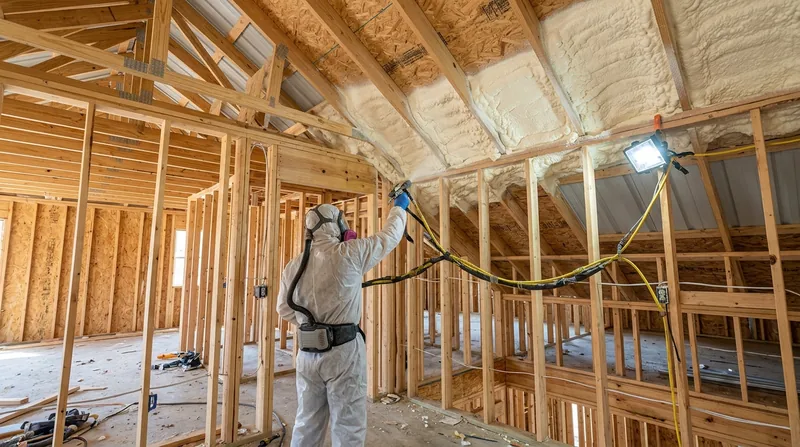




Commercial & New Construction Spray Foam in Tyler is specified before drywall closes the walls and before roof decks are sealed. Across Smith County, new slab-on-grade ranches in Chapel Hill, two-story subdivisions through Whitehouse and Lindale, and infill projects in the Azalea District all depend on foam to meet the energy code and to control the humidity that the Piney Woods climate drives into every building envelope. East Texas summers are long and cooling loads are steep, and the energy code that applies at your address sets the minimum R-value and the thermal barrier requirement that foam must satisfy. We work with builders and general contractors to size closed cell or open cell foam for the wall cavities, rim board, band joist, and roof deck before the trades close up the shell. Our approach is straightforward: write the estimate with R-value and thickness specs, follow the manufacturer ratio and drum temperature, use mechanical ventilation during cure, and respect the re-entry window that the product data sheet requires. The result is a tight, code-compliant envelope that holds its R-value and does not off-gas into the living space after occupancy.
Why Commercial & New Construction Spray Foam Matters in Tyler and Smith County
New construction in the Tyler market faces two competing pressures: the energy code that governs minimum insulation performance, and the climate reality that makes air sealing and vapor management non-negotiable. Vented attics and open crawl spaces work against you in this heat and humidity. Spray foam on the roof deck or in wall cavities before drywall closes eliminates the air leakage paths that would otherwise pull damp ground air and humid outdoor air into the conditioned space all summer long. The local building department enforces the energy code that applies at your address, and that code specifies R-value minimums and often requires a thermal barrier or ignition barrier on foam. Closed cell foam delivers high R-value in a thin profile, which matters when headroom is tight or when rim board and band joist space is constrained. Open cell foam costs less and still provides excellent air sealing and sound dampening, and is often the right choice for interior walls and non-structural cavities where the high R-value of closed cell is not required by code.
- We obtain and review the energy code that applies at your job site and specify foam type and thickness to meet or exceed the minimum R-value.
- We coordinate the spray date with your framing schedule so foam goes in after the envelope is dried in but before drywall crews begin.
- We provide written estimates that state the R-value, thickness in inches, and the foam type (closed cell or open cell) so your builder and the building inspector have clear documentation.
- We follow the manufacturer technical data sheet for drum temperature, mixing ratio, and application technique, and we use mechanical ventilation during cure to protect indoor air quality.
- We respect the re-entry window specified by the foam manufacturer, typically 24 to 48 hours, and we communicate that clearly to your project timeline.
Getting foam right on new construction is an investment in energy efficiency, code compliance, and occupant comfort from day one.
Key info: The energy code that applies to your project depends on your address within Smith County or the neighboring counties we serve. Tyler, Whitehouse, Lindale, and Bullard may each enforce different versions of the International Energy Conservation Code (IECC). We help you and your builder understand what applies at your site, but the final authority is always the local building department. Ask your builder which code edition is in force at your address, and we will spec the foam accordingly.
For more detail on how air sealing works hand-in-hand with foam, see our Air Sealing page.
How We Install Commercial & New Construction Spray Foam in Tyler
Our process begins with a site walkthrough and a conversation with the builder or general contractor about the energy code, the building schedule, and the specific areas where foam will be applied. We measure the square footage of walls, rim board, band joist, attic or sealed roof deck, and any other cavities that are part of the scope. We then provide a written estimate that specifies the foam type (closed cell or open cell), the target R-value, the thickness in inches, and the total board feet. Once you approve, we schedule the spray date to fit your framing timeline. On the day of the spray, we set up mechanical ventilation, control the drum temperature and mixing ratio to manufacturer spec, and spray in multiple thin passes to ensure even coverage and proper rise. After application, we allow the re-entry window specified in the product data sheet, typically 24 to 48 hours, before drywall or other finishing trades return to the space.
- We conduct an on-site survey of the building shell and identify all areas where foam will be applied.
- We write the estimate with R-value, thickness, board-foot total, and foam type clearly documented.
- We coordinate the spray date with your builder to fit the framing and drying-in schedule.
- We arrive with spray equipment, hoses, and mechanical ventilation fans, and we set up a controlled work zone.
- We spray in thin passes, monitoring temperature and ratio, and we document the application with photos and notes for the building inspector if required.
- We provide a re-entry window and a completion notice so your builder knows when the next trade can safely enter.
This step-by-step approach ensures the foam is applied correctly, meets code, and is documented for inspection and compliance.
Example: A two-story subdivision in Whitehouse with 24 new homes scheduled over six months requires rim board and band joist insulation on every unit, plus closed cell foam in the sealed attic cavities above the bonus rooms. We work with the builder's framing crew to spray each unit as soon as the envelope is dried in, typically within 2 to 3 weeks of framing completion. Each estimate documents the R-value, thickness, and board-foot count, and we keep the schedule tight so drywall can follow within 48 hours of cure completion.
For details on closed cell spray foam and its high R-value advantage, visit our dedicated page.
Spray Foam Application Methods: Closed Cell, Open Cell, and Combination Approaches
| Approach | Description | Best for |
|---|---|---|
| Closed Cell Foam | Rigid, high-density foam with R-value of 6.0 to 6.5 per inch. Resists moisture and provides air and vapor barrier in one pass. Requires thermal barrier or ignition barrier per code. | Rim board, band joist, sealed attic over conditioned space, metal building roof deck, areas where space is tight and high R-value per inch is needed. |
| Open Cell Foam | Lower-density, softer foam with R-value of 3.5 to 3.8 per inch. Allows vapor transmission, provides air sealing without vapor lock. Requires thermal barrier per code. | Interior wall cavities, non-structural walls, areas where vapor permeability is an advantage, budget-conscious new construction without high R-per-inch requirements. |
| Combination: Closed Cell Rim + Open Cell Walls | Closed cell on rim board and band joist (moisture and air barrier), open cell in interior wall cavities (cost savings, sound dampening, vapor permeability). | Mixed-use new construction where code requires high R-value on the thermal envelope but interior cavities can use lower-cost foam without sacrificing air sealing. |
| Sealed Attic with Closed Cell Roof Deck | Closed cell sprayed directly to underside of roof sheathing, creating a conditioned attic. Eliminates venting and ductwork temperature loss. Requires code-compliant thermal barrier. | New construction with bonus rooms, HVAC equipment, or ductwork in the attic. Eliminates the need for soffit vents and ventilation gaps, improving code compliance and energy performance. |
The choice between closed cell and open cell depends on the specific location in the building, the energy code requirement at your address, the available space, and the budget. We help your builder make that choice based on the building's design and the code that applies.
Commercial & New Construction Spray Foam Cost in Tyler: What to Expect
The cost of spray foam on a new construction project depends on the square footage of walls and cavities to be sprayed, the foam type (closed cell or open cell), the R-value target set by the energy code, and the accessibility of the spaces. A typical new slab-on-grade ranch with rim board and band joist insulation, plus open cell in wall cavities, will run lower than a two-story home with a sealed attic and closed cell roof deck foam. We provide a free commercial estimate that includes a site survey, measurement of all spray areas, and a written proposal with R-value, thickness, board-foot total, and foam type. That estimate is your starting point for budgeting and for comparison with other quotes.
Factors that move the cost up or down include the total square footage of the building envelope, the choice between closed cell and open cell foam, the complexity of the roof deck or attic shape, and the distance from our shop in Tyler to your job site. A simple rectangular ranch with rim board and open cell wall cavities will be less expensive per board foot than a complex two-story with sealed attic, bonus room cavities, and closed cell throughout. We also consider whether the building is dried in and ready for foam, or whether we need to coordinate closely with framing and drying-in schedules.
Get a free estimate by calling (430) 205-3083 or visiting our contact page. We respond within 24 hours and provide a detailed breakdown of what the foam will cost and why. For a full view of our pricing structure across all services, see our pricing page.
Commercial & New Construction Spray Foam Near Me: What to Look for When Hiring a Contractor in Tyler
When you are selecting a spray foam contractor for your new construction project, verify that the company is fully insured and ask to see the certificate of insurance. Ask for references from other builders or general contractors they have worked with, and call those references to ask about the quality of the spray, whether the job stayed on schedule, and whether there were any issues after the foam cured. Request a detailed estimate that includes the R-value, the thickness in inches, the total board feet, and the foam type, so you can compare apples to apples with other quotes. Do not accept an estimate with no R-value or no thickness specification, as that is a sign the contractor may not be paying close attention to code compliance or to the quality of the application.
Understand what your local building department requires. Tyler, Whitehouse, Lindale, Bullard, and other municipalities in Smith County and the surrounding counties each have their own contractor registration and permitting rules. Ask your builder or general contractor whether permits are required for spray foam work at your address, and whether the building inspector will need to sign off on the foam before drywall closes it in. Some jurisdictions require proof of contractor registration before a permit is issued, so confirm that with the building department early. Do not assume that any contractor you hire holds the registration your city requires. Ask them directly, and ask to see the documentation.
Verify that the contractor uses mechanical ventilation during the spray and cure process, and that they specify a clear re-entry window (typically 24 to 48 hours) before other trades can safely work in the space. Contractors who promise immediate re-entry or who do not use ventilation during cure are cutting corners, and that is a red flag. Ask whether the contractor will be on site during the spray or whether they send a subcontractor, and whether you can reach them directly if there are questions after the job is complete.
For more guidance on choosing a contractor and for a free estimate, contact us at (430) 205-3083 or visit our contact page. We are happy to answer your questions and to walk you through our process.
For additional context on how spray foam fits into the broader insulation and air sealing picture, see our homepage or our metal building spray foam page if your new construction includes a metal structure or barndominium.
Commercial & New Construction Spray Foam in Tyler: Pricing Guide
| Service | Price | Details |
|---|---|---|
| Free Commercial Estimate | Free | Site survey, measurement of spray areas, written proposal with R-value and thickness specs, no obligation |
| Closed Cell Foam (Rim, Band Joist, Sealed Attic) | Starting at $1.50-$2.25 per board foot | Price varies by total board feet, site access, and roof deck complexity. High R-value per inch, moisture and air barrier. |
| Open Cell Foam (Interior Walls, Non-Structural Cavities) | Starting at $0.65-$1.10 per board foot | Lower cost than closed cell, good air sealing and sound dampening. Board-foot total and cavity accessibility affect final price. |
| Combination Approach (Closed Cell Rim + Open Cell Walls) | Blended estimate | Custom proposal based on square footage of rim board and wall cavities. Balances code compliance with budget efficiency. |
| Travel and Coordination | Included | No separate mileage or travel fee within Tyler and surrounding service areas. Spray date coordination with builder schedule included. |
Indicative pricing, the exact cost depends on square footage, finish, and site access. Free personalized estimate within 24h at (430) 205-3083.


