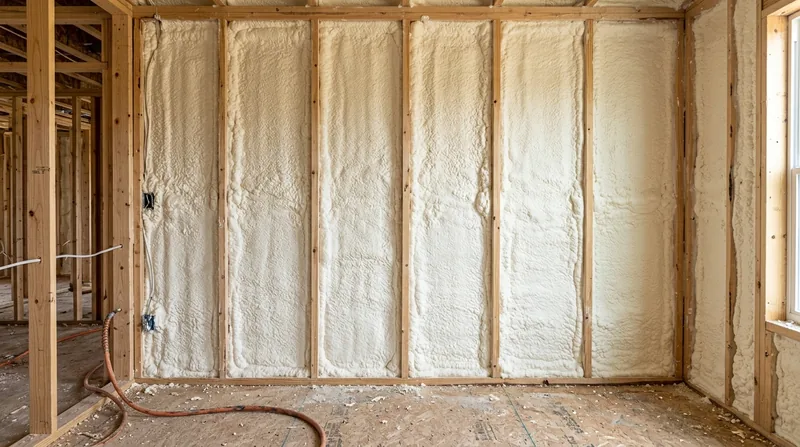




Open cell spray foam insulation in Tyler fills the stud bays and rafter cavities of the newer two-story homes that cluster through Whitehouse, Lindale, and the Flint area subdivisions, where bonus rooms over garages and long duct runs through hot attic space demand both air sealing and sound control. The Piney Woods heat and humidity that drive cooling loads most of the year make air leaks in these framed walls a direct hit to energy bills. Open cell foam expands soft and fills every cavity edge without the density penalty of closed cell, deadens sound transmission between floors and from exterior walls, and costs less per board foot than its denser cousin. Since 2010, we have sprayed open cell into the stud bays of hundreds of Tyler-area homes, retrofitting existing walls and new construction framing before drywall closes. A quick call to (430) 205-3083 gets you a free written estimate with R-value and thickness specs for your specific job.
Why Open Cell Spray Foam Makes Sense for Tyler's Newer Subdivisions
Tyler's residential growth since the 1990s has pushed new construction and major renovations into the rolling terrain south and west of the city center. Two-story homes with vaulted bonus rooms over garages, open-concept layouts, and complex roof lines are the norm in these subdivisions. Drywall goes up fast, but the framing underneath carries thermal bridges (studs, rim joists, band joists) and air leaks that fiberglass batts cannot seal. Open cell foam expands to fill every cavity, every corner, every gap around electrical boxes and rim band joists, stopping the convection that pulls hot humid air into the walls during the long cooling season.
- Open cell foam seals air leaks in stud cavities that fiberglass batts cannot reach, lowering cooling load on the air conditioner.
- The soft, permeable foam allows vapor to pass through, preventing moisture traps in walls during Tyler's hot humid summers.
- Sound transmission between floors and from exterior walls drops noticeably when stud cavities are filled with foam instead of air.
- Open cell costs less per board foot than closed cell, making it the right choice when air sealing and R-value are the goals and condensation control is not the constraint.
- New construction framing can be sprayed before drywall, capturing every cavity in one pass with no gaps or voids.
For homeowners and builders in Tyler's newer subdivisions, open cell spray foam is the practical answer to air leakage, uneven cooling, and sound control without the premium price tag of closed cell.
Key info: Tyler's building code is adopted locally by the City of Tyler and enforced by the Building Inspection Department. Thermal barrier and ignition barrier requirements for foam insulation are set in the energy and building code at your address. Your local building department can tell you what applies at your address.
How We Spray Open Cell Foam in Tyler Homes and New Construction
Open cell foam is sprayed from a heated two-component rig that mixes resin and isocyanate at the nozzle, delivering a low-pressure spray that expands and fills the cavity. The process is fast, clean, and repeatable. We start with a site inspection to identify the scope, check for moisture, verify access, and confirm the substrate is dry and ready. Then we set up mechanical ventilation, spray to the specified thickness in controlled passes, and establish a re-entry window so the foam can cure before drywall or finishing work begins.
- We inspect the framing and substrate to confirm conditions are dry and suitable for spray foam application.
- Mechanical ventilation runs during and after spraying to manage odor and ensure proper cure in the space.
- We spray to the thickness and R-value specified in your estimate, measured and documented on site.
- A re-entry window of 24 to 48 hours is established so the foam can cure before drywall, insulation, or other trades resume work.
- After cure, we can trim excess foam flush with the framing or leave a slight bulge for maximum contact with drywall.
This controlled, methodical approach is what separates a durable, high-performing installation from the rig-and-run crews that spray fast, promise immediate re-entry, and disappear when the smell will not go away.
Local example: A new construction home in the Chapel Hill area near Whitehouse had stud cavities and rim band joists sprayed with open cell to R-15 before drywall, sealing all the air leakage paths and improving the overall envelope tightness. The builder moved to drywall and finishing on schedule. The homeowner moved in with a tight, quiet, energy-efficient home.
Open Cell Spray Foam Methods and Applications
| Approach | Description | Best for |
|---|---|---|
| Stud bay fill | Spray open cell into exterior wall cavities from top plate to bottom plate, sealing all framing and electrical penetrations. | New construction before drywall, or retrofit walls where drywall has been removed for renovation. |
| Rim and band joist sealing | Fill the rim cavity and band joist cavity at the first-floor perimeter, eliminating convection and air infiltration at the foundation line. | Retrofit of existing homes with unconditioned rim cavities or new construction before rim board closure. |
| Rafter cavity fill | Spray open cell between rafter members in cathedral ceilings or vaulted bonus rooms, creating an air seal and insulation layer. | Bonus rooms over garages, cathedral ceilings, and vaulted spaces where traditional batts leave gaps and air leakage. |
| Sound dampening in interior walls | Fill interior wall cavities between bedrooms or between living spaces to reduce sound transmission and improve privacy. | Two-story homes with bedrooms stacked or adjacent, where noise isolation is desired without major structural changes. |
| Attic perimeter and band sealing | Spray open cell around the top plate perimeter and band joist area of an attic to seal air leakage paths before blown-in insulation is added. | Existing homes where attic air sealing is the priority and blown-in insulation covers the field afterward. |
Each method is chosen based on the framing geometry, the substrate condition, and the air leakage path you want to seal. We evaluate your specific wall, rafter, or rim condition on site and recommend the approach that delivers the best result for your budget and timeline. For more information on how open cell fits into a comprehensive insulation strategy, see our attic spray foam insulation and wall and injection foam pages.
Open Cell Spray Foam Insulation Cost in Tyler: What to Expect
Open cell spray foam in Tyler typically starts at $0.55 per board foot, with the final price determined by cavity depth, framing layout, substrate condition, and access. A stud bay fill in a new construction home with clean framing and easy access will land at the lower end. A retrofit of an existing wall with existing insulation removal, electrical rework, or tight access will run higher. The cost reflects the labor and material to spray to specification, set up ventilation, and manage cure time properly.
Several factors move the price:
- Cavity depth and framing layout determine how many passes are needed to reach the target R-value.
- Existing insulation removal adds labor if walls or cavities must be cleared before spraying.
- Access to the cavities, such as tight rim spaces or overhead rafter areas, affects setup and spray time.
- Substrate moisture or contamination may require remediation before foam can be applied safely.
- Complexity of the envelope, such as multiple angles, penetrations, or tight corners, increases labor per board foot.
We always provide a written estimate with R-value and thickness specs so you know exactly what you are paying for and why. Getting 2 to 3 estimates from different contractors is smart; compare the R-value, the thickness, the warranty, and the re-entry window, not just the price. A suspiciously low estimate with no R-value spec and a promise of immediate re-entry is a red flag. See our pricing overview for typical ranges across our service menu, and call (430) 205-3083 for your free estimate.
What to Look for When Hiring a Spray Foam Insulation Contractor Near Tyler
Open cell spray foam is a material and a process, not a product you can inspect after the fact. Once drywall goes up, the quality of the foam installation is hidden. That is why the contractor you hire, their equipment, their crew training, and their willingness to document the work matter more than price. A reputable contractor will provide a written estimate with R-value and thickness, run mechanical ventilation during cure, establish a clear re-entry window, and carry verifiable insurance. Ask any contractor to show you proof of insurance before work begins.
- Verify that the contractor is fully insured and ask to see a current certificate of insurance naming you as an additional insured.
- Get a written estimate that specifies the R-value, the foam thickness per pass, and the total board feet to be sprayed.
- Ask about the contractor's ventilation setup during cure and the re-entry window they guarantee before drywall or other trades resume work.
- Check references from recent jobs in Tyler or nearby areas, and ask those homeowners about the smell, the timeline, and the quality of the final result.
- Confirm what permits or registrations your city or county requires and verify that the contractor holds them before work begins.
- If your home is in a master-planned community or HOA, confirm that exterior work on metal buildings or additions complies with architectural review rules.
The local independent contractor with a local address, local plates, and a track record in Tyler is your best defense against the rig-and-run crews that spray fast and vanish when problems arise. Ready to move forward? Contact us at https://tyler-spray-foam.com/contact/ for your free written estimate, or call (430) 205-3083.
Open Cell Spray Foam Insulation in Tyler: Pricing Guide
| Service | Price | Details |
|---|---|---|
| Open cell stud bay fill | Starting at $0.55/board ft | Exterior wall cavities sealed and filled to specified R-value, includes mechanical ventilation during cure and 24-48 hour re-entry window |
| Rafter and cathedral ceiling foam | Starting at $0.55/board ft | Vaulted or cathedral cavities between rafters, bonus rooms over garages, multiple angles and access complexity may increase per-board-foot rate |
| Rim and band joist sealing | Starting at $0.60/board ft | Foundation perimeter cavities sealed, tight access and existing rim board removal add labor; retrofit jobs typically higher than new construction |
| Retrofit with existing insulation removal | On estimate | Removal of old fiberglass or mineral wool, disposal, substrate prep, and foam application require on-site assessment to price accurately |
| Travel and setup | Included | No separate mileage fee or travel charge within Tyler and surrounding service areas; setup and ventilation are part of the job cost |
| Free written estimate | Free | Response within 24 hours at (430) 205-3083, includes R-value, thickness specs, and board-foot calculation, no obligation to book |
Indicative pricing, the exact cost depends on square footage, finish, and site access. Free personalized estimate within 24h at (430) 205-3083.


