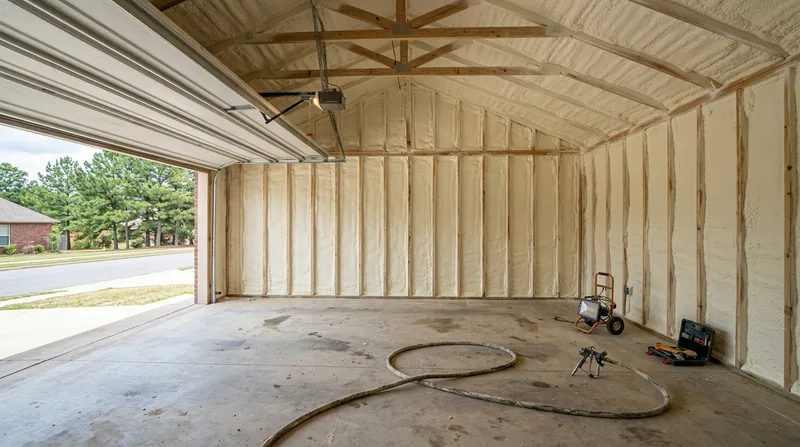




Garage spray foam insulation in Tyler blocks the heat and moisture that pour through shared walls and ceilings into your attached garage, where they damage stored items, warp doors, and work their way into the house. Newer subdivisions around Flint, Bullard, and Whitehouse sit in the rolling Piney Woods with hot attics and year-round humidity that turn uninsulated garage spaces into thermal liabilities. A garage ceiling and shared wall foam job stops that energy leak before it reaches your cars, tools, and the conditioned space beyond. We spray closed-cell or open-cell foam directly to the underside of your garage roof deck and against any wall shared with the house, creating a continuous air and thermal barrier that works even in the intense East Texas cooling season. The result is a garage that stays cooler, stays drier, and stops pulling humid air into your home.
Why Garage Spray Foam Insulation Matters in Tyler's Hot, Humid Climate
Tyler sits in climate zone 3A with hot summers that run eight months a year and humidity that never really leaves. An uninsulated garage ceiling and shared walls let the attic temperature swing from 130 to 140 degrees Fahrenheit in summer, and that heat radiates straight down into the garage and sideways into the house. Moisture drives inward during the cooling season because the garage stays warmer than the conditioned space next to it, creating a pressure difference that pulls damp air through every gap and seam. Over time, this cycle damages stored belongings, warps garage doors, and forces your air conditioner to work harder to maintain the house temperature.
- Spray foam stops heat transfer through the garage ceiling and shared walls, dropping attic heat gain into the house by 30 to 50 percent on that wall.
- A continuous foam barrier blocks air infiltration and moisture vapor, keeping the garage environment stable and dry year-round.
- Closed-cell foam also provides structural bracing to the roof deck and improves sound dampening from roof noise and weather.
- Open-cell foam costs less and works well in garages where the priority is temperature control rather than vapor resistance.
- Foam installed to the roof deck eliminates the need for soffit vents in that zone, simplifying the thermal envelope and reducing maintenance.
Garage insulation is one of the fastest paybacks in the home because the space is already framed and accessible, and the cooling load is immediate and measurable.
Key info: Garages in newer Bullard and Lindale subdivisions often sit directly under vented attics with no insulation between the garage ceiling and the attic space above. A 2-inch closed-cell foam layer stops the heat path and pays for itself in reduced air conditioning bills within three to five years in this climate.
For more information on how foam works in your specific building type, see our closed-cell spray foam insulation page.
How We Install Garage Spray Foam Insulation in Tyler
We start with a site visit to measure the garage ceiling, identify any shared walls with the house, and check for air leaks around doors, windows, and penetrations. We confirm that the roof deck and framing are dry and free of active leaks before we spray. We set up mechanical ventilation during the application to manage fumes, and we establish a clear re-entry window of 24 to 48 hours. Once the foam cures, we inspect the thickness and coverage to confirm it meets the R-value and specifications on your written estimate.
- We inspect the garage ceiling, shared walls, and roof structure for moisture, damage, or existing insulation that needs removal.
- We seal any large air leaks with foam or caulk before the main spray to ensure even coverage and to prevent foam from migrating into unwanted spaces.
- We spray the closed-cell or open-cell foam in passes that build to the specified thickness, typically 2 to 3 inches for garages in East Texas.
- We measure and document the final thickness and R-value on site and provide those details on your completion report.
- We apply a thermal barrier if required by code, which is typically a thin fire-rated coating on the foam face.
The whole job usually takes one to two days depending on garage size and whether we are also sealing rim joists or other connected spaces.
Example: A two-car garage in Tyler with a 400-square-foot ceiling and one shared wall with the house typically runs 3 to 4 hours of spray time and requires 80 to 120 board feet of foam at 2.5 inches thick. We finish the job in one day and the garage is ready for normal use within 48 hours.
If your garage also has exposed rim joists or a vented crawl space underneath, we can address those in the same visit. Learn more about rim and band joist insulation.
Garage Spray Foam Insulation Methods and Approach
| Approach | Description | Best for |
|---|---|---|
| Closed-Cell Foam | High-density foam sprayed at 1.5 to 3 inches, cures rigid, R-value 6.0 to 6.5 per inch, resists moisture and air infiltration completely. | Garage ceilings in humid climates, shared walls, and any space where vapor resistance and structural bracing matter. |
| Open-Cell Foam | Lower-density foam sprayed at 4 to 6 inches, cures soft, R-value 3.6 to 3.8 per inch, allows moisture to pass through, easier to cut and trim. | Garages where cost is the priority and the space is not subject to standing water or extreme humidity. |
| Ceiling Only | Foam sprayed to the underside of the garage roof deck, leaving walls and doors uninsulated, 2 to 3 inches typical. | Detached garages or spaces where only attic heat gain is the concern and the garage does not share a wall with the house. |
| Ceiling and Shared Walls | Foam applied to the ceiling and any wall that separates the garage from the conditioned house, creating a complete thermal and air barrier. | Attached garages in subdivisions like Bullard and Lindale where heat and humidity leakage into the house is the primary concern. |
The choice between closed-cell and open-cell comes down to your climate, the moisture load in the garage, and your budget. In Tyler's humid environment, closed-cell is the safer choice for attached garages, but open-cell works fine if the roof is sound and you keep the space ventilated.
Garage Spray Foam Insulation Cost in Tyler: What to Expect
A typical two-car garage ceiling in Tyler starts at around $1,200 to $1,800 for 2.5 inches of closed-cell foam covering 400 square feet. If you add a shared wall or choose open-cell foam, the price adjusts based on square footage and foam type. Access to the space, existing insulation that needs removal, and the complexity of air sealing around doors and penetrations all affect the final cost. We provide a written estimate on site with the R-value, thickness, and board-foot calculation so you know exactly what you are paying for.
The best way to understand the cost for your garage is to get a free estimate from us and compare it with one or two other local contractors. We respond within 24 hours and there is no obligation to book. Call us at (430) 205-3083 or visit our pricing page for more detail on what drives the cost up or down.
Financing options and energy may also apply to your project. Ask about those during your estimate call.
What to Look for When Hiring a Spray Foam Insulation Contractor Near Me in Tyler
The spray foam market in East Texas includes national franchises, out-of-state crews, and local independent shops. The honest differentiator is how the contractor handles the basics: a written estimate that names the R-value and thickness, mechanical ventilation during the spray, and a realistic re-entry window. Avoid any contractor who promises immediate occupancy, quotes a price without measuring the space, or cannot explain why they chose closed-cell or open-cell for your situation.
Verify that any contractor you hire is fully insured and ask to see the certificate of insurance before work begins. Ask for references from recent jobs in Tyler or nearby towns like Whitehouse, Lindale, and Bullard. Confirm that the contractor understands what permits or approvals your city or county may require for the work, and that they will help you navigate those requirements. If you have an HOA, check whether the organization has any rules about exterior work or roof modifications that might apply to your garage.
We are fully insured, we provide written estimates with R-value and thickness specifications, and we have been serving Tyler and surrounding areas since 2010. Contact us at (430) 205-3083 for a free estimate and we will walk you through the whole process.
Garage Spray Foam Insulation in Tyler: Pricing Guide
| Service | Price | Details |
|---|---|---|
| Garage Ceiling Insulation | Starting at $1,200 | Two-car garage, 2.5 inches closed-cell foam, 400 square feet, includes R-value documentation and thermal barrier if required |
| Ceiling and Shared Wall Insulation | Starting at $1,600 | Two-car garage plus one shared wall with house, closed-cell or open-cell foam, 500 to 600 square feet total coverage |
| Single-Car Garage or Detached Building | Starting at $800 | Smaller ceiling area, 2 to 3 inches foam, lower board-foot volume, same R-value documentation and quality standard |
| Insulation Removal Before Spray | On estimate | If old blown-in, fiberglass batts, or failed foam must be removed first, cost depends on material type and square footage |
| Travel and Site Visit | Included | No separate mileage or call-out fee for Tyler and surrounding service areas within 30 miles of our shop |
| Free Written Estimate | No charge | On-site measurement, R-value calculation, thickness specification, and realistic price range, response within 24 hours |
Indicative pricing, the exact cost depends on square footage, finish, and site access. Free personalized estimate within 24h at (430) 205-3083.


