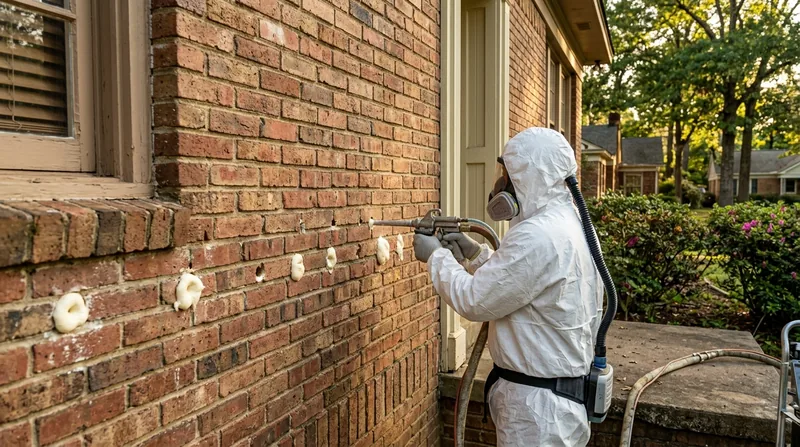




Older brick homes in Tyler's Azalea District and throughout East Texas often have hollow wall cavities that leak conditioned air year-round, driving up cooling costs in the hot, humid Piney Woods climate. Wall and injection foam insulation seals those cavities from the inside without disturbing the exterior brick or siding, stopping drafts and moisture infiltration that fiberglass batts and blown-in cellulose simply cannot reach. Over fourteen years, we have injected foam into hundreds of pre-1980 walls across Tyler, Whitehouse, Lindale, and Bullard, restoring comfort to homes that were built before modern air barriers existed. The process is fast, non-invasive, and works in occupied homes. If your heating and cooling bills climb despite new equipment, or if you feel drafts along exterior walls even on calm days, the cavity is almost certainly open to the outdoors. We drill small holes, inject closed-cell or open-cell foam to fill the void, seal the holes, and the wall becomes a thermal and moisture barrier again.
Why Wall and Injection Foam Insulation Matters in Tyler's Climate
The Piney Woods of East Texas sit in IECC climate zone 3A, where cooling dominates the energy picture from May through October and humidity stays high nearly year-round. Vapor drives inward during summer, and any wall cavity open to the attic or exterior rim becomes a highway for hot, moist air. Brick and fiber-cement siding trap that moisture against the sheathing, leading to rot, mold, and structural decay over time. Injection foam stops the air leak and the vapor drive in one step, which no other retrofit method can do without tearing into the wall.
- Hollow brick walls and cavity block lose 40 to 60 percent of their R-value when air infiltrates from the rim or attic.
- Injection foam fills the entire cavity uniformly, eliminating cold spots and convection loops that fiberglass batts cannot seal.
- Closed-cell foam provides vapor resistance, critical in Tyler's humid climate where summer moisture drives inward.
- Open-cell foam works in walls where vapor permeability is desired and the wall is protected from external moisture.
- The process takes one day and requires no interior demolition, drywall repair, or painting.
Sealing a wall cavity stops the energy leak at its source and protects the structure from the moisture that causes long-term damage in our climate.
Key info: A brick home in Tyler's Azalea District with 1,500 sq ft of exterior wall cavity can lose 8 to 12 tons of conditioned air per year through infiltration alone. Injection foam typically costs less than $2 per square foot and pays for itself in 3 to 5 years through reduced cooling bills.
For more context on how spray foam works in attics and other cavities, see our attic spray foam insulation service.
How We Inject Foam into Walls: Process and Technique in Tyler
Wall injection is a measured, deliberate process. We begin with a site inspection to locate the cavity, determine its depth and width, and identify any existing insulation or obstructions. We then drill small holes (typically 1 to 1.5 inches) at intervals along the wall, inject foam at low pressure to fill the cavity completely without over-pressuring the wall assembly, and seal each hole with a matching plug. The entire job happens from outside, with no interior disruption. Cure time is 24 to 48 hours before the wall returns to full service.
- We inspect the wall cavity using thermal imaging or by probing to confirm it is empty and dry before injecting.
- Holes are drilled at 16-inch intervals vertically, staggered between studs to ensure complete fill.
- Foam is injected at controlled pressure and flow rate, monitored continuously to prevent over-fill and wall damage.
- Each hole is sealed with a foam plug and finished to match the existing siding or brick.
- We photograph the work and provide documentation of R-value and thickness per cavity.
This method works on brick, fiber-cement, vinyl, and wood siding, and on both single-wythe and double-wythe brick construction.
Example: A 1920s brick cottage in Whitehouse with 2x4 stud cavities and no existing insulation was injected with 2 pounds per cubic foot closed-cell foam to R-15 equivalent. The job took one day, cost $1,800 for 900 linear feet of wall, and reduced summer cooling bills by 18 percent in the first year.
Learn more about closed-cell spray foam insulation and when it is the right choice for your walls.
Wall and Injection Foam Methods: Closed-Cell vs. Open-Cell
| Approach | Description | Best for |
|---|---|---|
| Closed-Cell Injection | 2 lb/cu ft density, R-6.5 per inch, vapor-impermeable, rigid when cured. | Brick walls, humid climates, cavities exposed to exterior moisture, structural reinforcement. |
| Open-Cell Injection | 0.5 lb/cu ft density, R-3.5 per inch, vapor-permeable, soft when cured, lower cost. | Interior walls, non-humid cavities, homes where vapor drive is managed by exterior barriers. |
| Blow-In Cellulose or Fiberglass | Loose-fill alternative, R-3.2 to R-3.8 per inch, settles over time, does not seal air. | Top-up of existing partial insulation in horizontal cavities only, never vertical walls. |
| No Action | Existing cavity remains open to attic or exterior, convection continues, moisture infiltrates. | Not an option if you want to reduce energy bills or protect the wall structure from rot. |
Closed-cell foam is the industry standard for wall injection in Tyler because it stops both air and moisture in one pass, and because the Piney Woods humidity makes vapor control essential.
Wall and Injection Foam Insulation Cost in Tyler: What to Expect
Wall and injection foam insulation in Tyler typically starts at around $2 per square foot of wall cavity treated, though the final cost depends on several site-specific factors. A typical 1,500 sq ft home with 900 linear feet of exterior wall cavity at an average height of 8 feet costs $1,600 to $2,400 for closed-cell injection. Open-cell injection runs 20 to 30 percent less. The price moves based on cavity width and depth, wall height, accessibility (single-story vs. two-story), existing obstructions, and the number of holes required to ensure complete fill.
Access is the biggest cost driver. A brick home on a slab with clear ground access costs less than a two-story home in Lindale or Bullard where we need scaffolding or lifts to reach upper walls. Pre-1970 homes with 2x4 studs and 3.5-inch cavities are cheaper to fill than 1920s brick with irregular wythe spacing. If the cavity is partially blocked by old insulation, settling, or debris, labor increases.
We provide a written estimate on site that specifies the R-value per cavity, the foam type, the square footage treated, and the total cost. We recommend getting 2 to 3 estimates from local contractors so you can compare specifications, not just price. The cheapest estimate is often the one with no R-value listed, no thickness spec, and no insurance verification. For detailed pricing and to book a free estimate, visit our pricing page or call us at (430) 205-3083.
Wall and Injection Foam Insulation Near Me: What Tyler Homeowners Should Know Before Hiring
Hiring a spray foam contractor is a decision that affects your home's comfort, energy bills, and structural health for decades. Before you call, know what to ask and what to verify. Any contractor working in your city or county may be required to register with the local building department before pulling a permit or starting work. Ask any contractor, including us, what registration your city requires and confirm they hold it before work begins. Request proof of insurance and verify the policy is active with the carrier. Get the estimate in writing with R-value, thickness, foam type, and total square footage specified. If the estimate has none of these details, walk away.
- Verify that the contractor is fully insured and ask for a certificate of insurance naming your address.
- Request references from three to five jobs in Tyler or nearby cities completed in the past 12 months.
- Confirm that the contractor will provide mechanical ventilation during cure and specify the re-entry window in writing (typically 24 to 48 hours).
- Ask whether the estimate includes a site inspection, written specs, and a workmanship warranty period.
- Check that the contractor has a local address and phone number you can reach if questions arise after the job is done.
The local independent contractor with a Tyler address and local plates is your best position against both rig-and-run crews and national franchises that disappear when the smell lingers or the foam cures unevenly. We hold a local address, we carry full insurance, and we stand behind our work with a one-year workmanship warranty. For a free, no-obligation estimate, contact us today.
Wall & Injection Foam Insulation in Tyler: Pricing Guide
| Service | Price | Details |
|---|---|---|
| Wall Injection, Closed-Cell Foam | Starting at $2/sq ft | Complete cavity fill with R-6.5 per inch, moisture barrier, includes site inspection and sealed holes |
| Wall Injection, Open-Cell Foam | Starting at $1.40/sq ft | Lower-cost option for interior walls, R-3.5 per inch, vapor-permeable, same labor and sealing included |
| Cavity Width and Obstruction Assessment | Included | On-site evaluation determines cavity depth, identifies partial fill or debris, adjusts labor estimate accordingly |
| Multi-Story or Scaffolding Required | On estimate | Two-story homes or difficult access add equipment and labor cost, determined at inspection |
| Travel and Mobilization | Included | No separate charge for Tyler, Whitehouse, Lindale, Bullard, Jacksonville, and surrounding Smith County areas |
| Free Written Estimate | No charge | Includes R-value, thickness, foam type, square footage, and total price, response within 24 hours |
Indicative pricing, the exact cost depends on square footage, finish, and site access. Free personalized estimate within 24h at (430) 205-3083.


