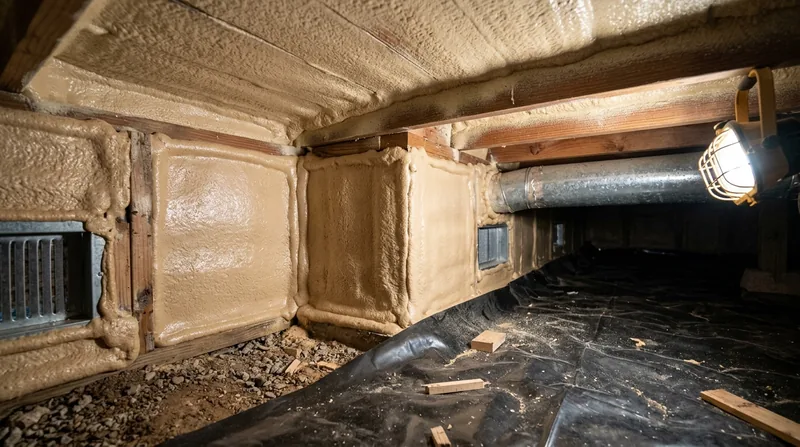




Closed cell spray foam insulation in Tyler is the high-performance answer to the Piney Woods heat and humidity that defines East Texas. Tyler sits in climate zone 3A with hot, humid summers that last most of the year, and the occasional ice storm that tests every seal in your home. Older brick homes in the Azalea District sit over ventilated crawl spaces that pull damp ground air into framing year-round. Mid-century slab-on-grade ranches have flattened attic insulation baking under ductwork in vented attics. Newer subdivisions from Whitehouse to Lindale bring two-story homes with bonus rooms and long duct runs through hot attic space. Closed cell foam stops that moisture infiltration cold, building a rigid air barrier at rim joists, crawl space walls, and sealed attics that blocks vapor before it reaches wood. We have been installing closed cell foam in Smith County and across Greater Tyler since 2010, and we know exactly where it stops the leak and where it does not.
Why Closed Cell Spray Foam Stops Moisture Damage in Tyler Homes
Humidity in Tyler stays high nearly year-round, and in summer the vapor drive runs inward. Vented attics and open crawl spaces end up pulling that moisture into the house instead of keeping it out. Closed cell foam is rigid, impermeable, and does not absorb water the way fiberglass does. When sprayed at rim joists in older homes or at crawl space walls in pier-and-beam houses, it blocks both air infiltration and vapor transmission in a single pass. That matters because a damp crawl space under a wood-frame floor does not stay dry just by ventilation in East Texas. Ice storms that hit Henderson, Van, and the rural reaches of Rusk County also load the roof deck with weight and long cold winters that crack foam that was not anchored properly to the substrate. Closed cell takes that load.
- Closed cell foam stops vapor drive inward during Tyler's long humid summers when open crawl spaces and vented attics fail.
- It creates a rigid air seal at rim joists and band joists in Azalea District homes, blocking the path moisture takes into framing.
- Closed cell does not absorb water, so it stays effective even when damp ground air reaches the crawl space wall.
- The density of closed cell (3.5 to 4.5 lbs per cubic foot) carries structural load from ice storms and roof weight.
- It holds its R-value (5.5 to 7.0 per inch) in the presence of moisture, unlike fiberglass.
Getting the substrate right before spray matters. We do not spray over wet, contaminated, or actively leaking surfaces. If a crawl space has standing water or a roof is actively leaking, we fix the moisture first or we walk away. That is the mark of an honest installer and the reason homeowners in Tyler call us back.
Key info: A pier-and-beam home in Whitehouse with a damp crawl space and bare subfloors can drop interior humidity and stop wood rot in the rim joist when closed cell foam seals the band joist and lower rim. The job costs more than fiberglass, but the crawl space stays dry and the framing lasts.
For a detailed breakdown of how closed cell compares to open cell and other approaches, see our open cell spray foam page.
How We Install Closed Cell Spray Foam in Tyler: The Process
Closed cell installation is not a spray-and-walk job. We start with a site inspection and a written estimate that names the R-value, the thickness we will spray, and the board footage we expect. We check the substrate for moisture, assess access, and flag any moisture sources that need to be addressed first. The rig arrives with a two-component spray system that holds the resin and catalyst at the right temperature. We lay plastic and tape to protect areas we do not want sprayed. Mechanical ventilation runs during the cure period. We do not promise immediate re-entry. The industry standard is twenty-four to forty-eight hours before the space is safe to occupy.
- We inspect the substrate and confirm moisture sources are addressed before any foam is sprayed.
- The estimate is written and names the R-value per inch, the target thickness, and the total board footage.
- We set up mechanical ventilation before spraying and maintain it for the full cure window.
- Closed cell is sprayed in multiple passes, each controlled for thickness and coverage.
- We apply a thermal barrier or ignition barrier as your local building code requires at your address.
- The job is inspected before we leave, and we provide a photograph or measurement log of the work.
The cure time is real. A sealed attic in a two-story home in Lindale that we sprayed last year had a twenty-four hour re-entry window because we used mechanical ventilation and the foam cured fast. The homeowner was back in the bonus room the next day. That is the outcome of doing the ventilation right.
Example: A metal building shop in Henderson with a steel roof deck and no insulation had condensation dripping onto equipment every humid morning. We sprayed 2 inches of closed cell to the underside of the deck, built a continuous vapor barrier, and the condensation stopped. The building stayed dry and the equipment stayed clean.
Learn more about the specific applications we handle by visiting our crawl space spray foam page and our attic spray foam page.
Closed Cell Spray Foam Methods and Applications
| Application | Description | Best for |
|---|---|---|
| Rim Joist and Band Joist Sealing | Closed cell sprayed directly to the rim and band joist in pier-and-beam homes, blocking air and vapor infiltration from crawl space to interior. | Older Azalea District homes with damp crawl spaces and wood rot risk in framing. |
| Crawl Space Wall Foam | Closed cell applied to interior crawl space walls from rim to subfloor, creating a moisture barrier against ground vapor. | Ventilated crawl spaces with high humidity and bare subfloors in Smith County and Van Zandt County homes. |
| Sealed Attic Deck | Closed cell sprayed to the underside of the roof deck, sealing out heat and humidity while creating a conditioned attic space. | Two-story homes with bonus rooms, HVAC ductwork in attic, and long cooling season loads in Whitehouse and Lindale. |
| Metal Building Roof Deck | Closed cell adhered to steel roof decks and sidewalls, preventing condensation and moisture accumulation inside the building envelope. | Agricultural buildings, equipment shops, and rural metal structures across Henderson, Rusk, and Cherokee counties. |
| Garage Ceiling and Sidewall | Closed cell applied to garage ceiling and upper sidewalls to reduce heat gain and improve comfort in conditioned space above. | Two-story homes with conditioned living space above an attached garage in newer subdivisions. |
Each application starts with the same principle: seal the thermal and moisture boundary with a continuous, rigid air barrier. Closed cell is the right choice when vapor control and structural support matter as much as R-value.
Closed Cell Spray Foam Insulation Cost in Tyler: What to Expect
Closed cell spray foam in Tyler starts at $1.20 per board foot for straightforward applications like rim joist sealing in standard homes. The actual cost of your job depends on several concrete factors. The size of the area being sprayed, the thickness required by your building code or energy goals, the condition of the substrate, and the access we have to the space all move the price. A crawl space with tight clearance and old debris costs more to prep and spray than a clean, open band joist. A sealed attic with complex geometry and multiple roof penetrations costs more than a simple flat surface. Ice damage or prior failed insulation that needs removal adds labor and disposal cost. Travel within Tyler and the surrounding service areas is included in our estimate.
We provide a written estimate with R-value and thickness specified before work begins. That estimate is free, with no obligation to book. We respond within 24 hours at (430) 205-3083. Getting two or three estimates from different installers is smart. Ask each contractor for the R-value per inch, the target thickness, the total board footage, and the warranty on workmanship. A low-ball estimate with no details is a red flag. The price should make sense for the scope, the material, and the labor. For a full pricing breakdown and to see what other homeowners in Tyler have paid, visit our pricing page.
Closed Cell Spray Foam Insulation Near Me: What Tyler Homeowners Should Know When Hiring
Finding the right spray foam contractor near Tyler means knowing what to ask and what to verify. Texas regulates contractors at the municipal level, not the state level, so requirements vary from city to city. Before you hire any contractor, including us, ask what registration your city or county requires and confirm they hold it. Insurance matters. We are fully insured, and we provide proof of coverage on request. Get multiple estimates. A real estimate is written, names the R-value and thickness, and explains what is included. Check references. Ask to speak with homeowners in Tyler or Whitehouse who had closed cell foam installed in the last two years. Understand the cure window. Closed cell takes twenty-four to forty-eight hours to cure fully. If a contractor promises immediate re-entry, walk away. Mechanical ventilation during cure is not optional. Ask about the thermal barrier or ignition barrier required by your local building code. Some jurisdictions require a fifteen-minute thermal barrier on spray foam in certain applications. A contractor who does not name it correctly does not understand the code.
- Confirm that any contractor you hire holds the contractor registration your city requires.
- Ask for proof of insurance and confirm it covers spray foam installation in your jurisdiction.
- Request a written estimate that specifies R-value per inch, target thickness, and total board footage.
- Ask for references from Tyler-area homeowners and call them to ask about the cure window and the quality of the installation.
- Verify that the contractor uses mechanical ventilation during cure and respects the re-entry window.
- Confirm what thermal or ignition barrier your building code requires and that the contractor names it correctly.
The difference between a local independent contractor and a national franchise or a rig-and-run crew is accountability. If the smell will not go away, if the foam cured unevenly, or if you have questions three months later, you need to reach someone local who will answer the phone. We are at our contact page or call us at (430) 205-3083 to schedule a free estimate.
Closed Cell Spray Foam Insulation in Tyler: Pricing Guide
| Service | Price | Details |
|---|---|---|
| Rim Joist and Band Joist Sealing | Starting at $1.20/board ft | Entry-point application for moisture control in pier-and-beam homes. Cost depends on linear feet of joist and thickness needed. |
| Crawl Space Wall Foam | Starting at $1.20/board ft | Sealed wall barrier against ground vapor. Total cost varies by square footage of wall, height of application, and substrate condition. |
| Sealed Attic Installation | Starting at $1.35/board ft | Higher density and thickness for roof deck application. Cost depends on total square footage, roof pitch complexity, and thermal barrier code requirements. |
| Metal Building or Barndominium Roof Deck | Starting at $1.30/board ft | Condensation control on steel. Cost varies by building square footage, roof pitch, sidewall height, and prior insulation removal. |
| Removal of Failed or Old Insulation | On estimate | Necessary before retrofit. Cost depends on insulation type, volume, accessibility, and disposal requirements. |
| Travel and Free Estimate | Included / Free | No mileage fee or travel charge within Tyler and service areas. Estimate response within 24 hours, no obligation to book. |
Indicative pricing, the exact cost depends on square footage, finish, and site access. Free personalized estimate within 24h at (430) 205-3083.


