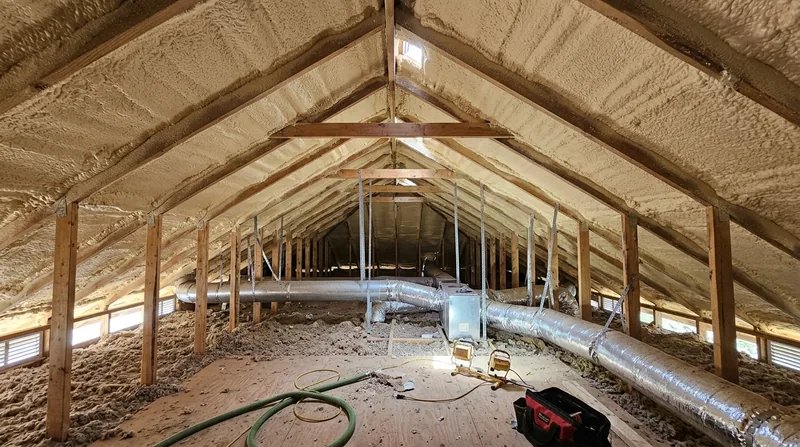




Attic spray foam insulation in Tyler stops the heat that bakes through vented attic spaces most of the year in the Piney Woods. Tyler sits in IECC climate zone 3A with hot, humid summers and cooling loads that run from late spring through early fall. Slab-on-grade ranches built in the mid-twentieth century have original fiberglass insulation flattened under ductwork, while newer two-story homes in Whitehouse, Lindale, and Chapel Hill have bonus rooms over garages with long duct runs exposed to attic heat. Spray foam sealed against the roof deck cuts that thermal loss, stops moisture drift in from vented spaces, and lowers the cooling load your air conditioner has to fight. We spray the roof deck, seal air leaks around penetrations and ductwork, and leave your attic tight and conditioned. Learn more about our closed cell spray foam and open cell spray foam options to find the right fit for your home.
Why Attic Spray Foam Insulation Matters in Tyler's Hot Climate
Tyler attics reach temperatures well over 130 degrees Fahrenheit on summer afternoons, and that heat migrates down into living spaces through ceiling joists, ductwork, and air leaks. Vented attics pull humid outside air through soffit vents, and that moisture condenses on cool duct surfaces or drywall, creating the conditions for mold and rot. Fiberglass batts and blown-in cellulose cannot stop this air movement or moisture drift. Spray foam seals the roof deck and creates a continuous thermal and moisture barrier that keeps hot, humid air out and conditioned air in.
- Stops heat gain through the roof deck and reduces cooling load on your air conditioner year-round.
- Seals air leaks that fiberglass cannot address, preventing moisture from entering the attic from vented soffit spaces.
- Allows you to move ductwork and mechanical equipment into conditioned space without the risk of sweat and condensation.
- Protects against the seasonal humidity spikes that plague vented attics in East Texas from May through September.
In Tyler, where cooling bills run high and humidity stays elevated nearly year-round, a sealed attic pays for itself faster than in climates with true winters.
Key info: A homeowner in Bullard with a 1,500-square-foot attic of vented fiberglass can expect to move ductwork into the sealed attic cavity and lower cooling costs by cutting duct heat gain. That same benefit is not available with a vented attic, no matter how thick the batts.
For guidance on what your city or county requires before work begins, contact your local building department or ask any contractor for the registration their municipality requires and confirm it before signing an agreement. The City of Tyler and surrounding municipalities set contractor registration rules locally, and no two are identical.
How We Spray Foam Your Attic in Tyler
Every attic spray foam job starts with a walk-through to measure the space, identify existing insulation and ductwork, check for moisture or roof leaks, and determine whether we seal the roof deck or the attic floor. We assess ventilation, penetrations, and the condition of the substrate. Once we understand the scope, we provide a written estimate with R-value, thickness, and board footage so you know exactly what you are paying for. We then schedule the work, set up mechanical ventilation during the spray and cure period, and ensure the attic reaches safe re-entry conditions within twenty-four to forty-eight hours.
- We inspect the attic for moisture, roof leaks, or contamination and address any substrate issues before foam is applied.
- We spray closed cell or open cell foam to the specified thickness and density per the manufacturer ratio and drum temperature.
- We run mechanical ventilation during application and cure to manage odor and ensure air quality throughout the process.
- We seal air leaks around ductwork, electrical penetrations, and rim joists as part of the installation.
- We provide a final walkthrough and explain the curing timeline and any temporary odor or off-gassing you may notice.
The entire job, from estimate to cure, is handled by our crew with no subcontractors, so you have one point of contact and one insurance policy covering the work.
Local example: A 1,200-square-foot sealed roof deck in Lindale with 5.5 inches of closed cell foam takes one day to spray and cure, with mechanical ventilation running throughout. The homeowner can re-enter safely the next morning and begin moving ductwork or equipment into the now-conditioned attic space.
If you need insulation removal before we spray, we handle that too, so your attic starts clean.
Attic Spray Foam Methods and Approaches
| Approach | Description | Best for |
|---|---|---|
| Sealed Roof Deck (Closed Cell) | Spray foam directly against the underside of the roof sheathing, creating a vapor barrier and air seal in one pass. Thickness typically 5.5 to 7 inches for R-value of 38 to 49. | Slab-on-grade ranches and newer homes with ductwork in the attic; hot, humid climates where moisture control is critical. |
| Sealed Attic Floor (Open Cell) | Spray open cell foam over the attic floor joists and rim band, sealing air leaks while allowing the attic to breathe. Typical thickness 5.5 to 8 inches for R-value of 19 to 28. | Budget-conscious retrofits; attics with soffit ventilation that will remain vented; homes where vapor permeability is preferred. |
| Closed Cell Roof Deck with Blown-In Attic Floor | Spray closed cell against the roof deck to seal and create a moisture barrier, then blow cellulose or fiberglass over the floor joists for additional R-value at lower cost. | Homes where the attic remains vented below the foam; maximum R-value on a modest budget; bonus rooms over garages. |
| Rim and Band Joist Foam | Spray closed cell foam into rim joists and band joists at the perimeter of the attic or where the attic meets the exterior wall, sealing the single largest air leak in most older homes. | Pier-and-beam homes in Tyler and older brick houses; any attic retrofit where air sealing is the priority; crawl space moisture control. |
Each approach has a cost and performance trade-off. See our pricing overview for starting figures and call us at (430) 205-3083 for a free estimate tailored to your attic and your goals.
Attic Spray Foam Insulation Cost in Tyler: What to Expect
Attic spray foam insulation cost in Tyler starts at approximately $1.50 per square foot for open cell foam on an attic floor retrofit, and ranges upward to $3.00 to $4.00 per square foot for closed cell foam sealed against the roof deck. The total cost depends on the square footage of the attic, the R-value and thickness you choose, whether existing insulation must be removed, accessibility of the space, and the complexity of ductwork or mechanical equipment already in place. A typical 1,200-square-foot attic sealed with 5.5 inches of closed cell foam costs between $3,600 and $5,400 before any removal work. If your attic has old fiberglass or cellulose that must come out first, add the cost of insulation removal, which is priced by the square foot and the volume of debris.
We always provide a written estimate with the board footage, R-value, and thickness specified so you can compare apples to apples with other contractors. Getting two or three estimates is smart practice and helps you understand why prices vary. Beware of estimates with no R-value listed, no thickness specified, or a price far below market with no on-site inspection. Those are signs of a rig-and-run crew that will spray fast, leave you with an odor problem, and be unreachable when the smell will not go away.
Factors that move cost up include difficult attic access (very low clearance, tight stairwells, or crawl spaces), the need to spray around existing ductwork without disturbing it, roof leaks or moisture that must be addressed first, and the removal and haul of old insulation. We never spray over a wet or contaminated substrate, so if your attic has moisture, we fix that first or we walk away.
What to Look for When Hiring an Attic Spray Foam Insulation Contractor Near Me
Finding a spray foam insulation contractor near Tyler that you can trust starts with verifying their insurance and asking for references from recent attic jobs in your area. A reputable contractor carries general liability and workers compensation insurance and can provide a certificate of insurance before work begins. They should give you a written estimate with R-value, thickness, and board footage, never a vague price per square foot or a quote over the phone without a site visit. Ask about their ventilation setup during spray and cure, their re-entry timeline, and whether they carry a workmanship warranty on the installation itself.
- Verify that any contractor you hire holds the contractor registration your city or county requires before signing an agreement.
- Ask for references from three or more recent attic spray foam jobs and call them to ask about odor, timeline, and post-installation support.
- Request a written estimate that lists R-value, thickness in inches, and total board footage so you can compare quotes accurately.
- Confirm that the contractor will run mechanical ventilation during spray and cure and will not promise immediate re-entry or move-in.
- Check that the contractor is fully insured and can provide a certificate of insurance naming you as an additional insured for the duration of the job.
If you have an HOA or architectural restrictions on your home, ask whether spray foam work requires approval before we schedule. Most HOAs do not govern interior attic work, but some master-planned communities in the Lindale and Chapel Hill areas have rules about exterior venting or mechanical work. We can help you navigate what applies at your address.
Ready to get started? Contact us for a free estimate or call (430) 205-3083. We respond within 24 hours with no obligation to book.
Attic Spray Foam Insulation in Tyler: Pricing Guide
| Service | Price | Details |
|---|---|---|
| Open Cell Attic Floor Retrofit | Starting at $1.50/sq ft | Budget-friendly air sealing over attic floor joists, typically 5.5 to 8 inches, R-19 to R-28, ideal for vented attics |
| Closed Cell Sealed Roof Deck | Starting at $3.00/sq ft | Spray against underside of roof sheathing, 5.5 to 7 inches, R-38 to R-49, includes moisture barrier and full attic conditioning |
| Rim and Band Joist Foam | Starting at $2.50/sq ft | Closed cell spray at attic perimeter, seals largest air leak in older homes, typical 2 to 4 inches of coverage |
| Insulation Removal and Replacement | On estimate | Cost depends on volume of old insulation, accessibility, and hazardous material assessment before spray foam work begins |
| Travel | Included | No mileage fee or travel charge for jobs in Tyler and surrounding Smith, Van Zandt, Gregg, Cherokee, and Rusk counties |
| Free Written Estimate | No charge | On-site inspection with R-value, thickness, and board footage specified, response within 24 hours at (430) 205-3083 |
Indicative pricing, the exact cost depends on square footage, finish, and site access. Free personalized estimate within 24h at (430) 205-3083.


